Abdulah Gul and Tayip Erdogan
I have read so many negative stories about AK Party (Turkey’s ruling party) over the last 4 years and have heard almost every possible criticism of them. The problem is that these complaints almost always seem to be based on emotion, fear, urban legend and hate rather than clearly documented evidence about their so-called “Islamic Agenda”.

I tend to give AKP the benefit of the doubt and have had a deep down feeling that the charges against them are exaggerated.

I came across an article today on Newsweek that (although dated, it’s a month old) seems to lay out the case against AK party in a non-sensational but honestly critical way. I liked that. I encourage you to check it out. I think you’ll find it to be critical in a way that’s fair. I like that, that’s the way I hope to be dealt with by my critics.

Click on the sample quote below to read the whole article

On economic matters, it has shown evidence of liberalism. Its pro-market policies helped the Turkish economy grow at an annual rate of more than 5 percent between 2003 and 2007. Yet this economic liberalism stops when it comes to labor rights. In May, police bludgeoned thousands of labor-union members in Istanbul during what was to be a peaceful May Day rally—a reminder of Prime Minister Recep Tayyip Erdogan’s warning to aggrieved union members that “where the feet rule the head, there is kiyamet [Muslim Judgment Day].”

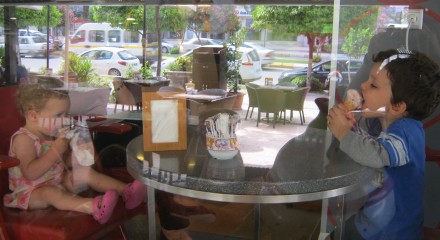
For those of you who aren’t my facebook friends, I thought I should treat you to some recent photos of Aksel, enjoy.


The BBC reports that the popular tran-sexual Turkish singer Bulent Ersoy will face up to 4 and a half years in prison for questioning the Turkish military’s actions in North Iraq on a popular American Idol type television show last February.

Her statement:

“If I had given birth to a child and someone sitting at a desk had said ‘You will do this, he will do that’, and I would then have to bury my child, would you find that acceptable?”

I guess this is a good warning to all of us, especially bloggers to be careful with our criticism of Turkey, especially powerful symbols of Turkey like the Army. This was a good warning for me as well. I was going to make a statement about Bulent Ersoy’s makeup and clothing being the most consistently hideous example of femininity that I’ve ever seen, but I’ve reconsidered. She is such a powerful symbol of Turkish music, thus of Turkey, that I’d hate to be given a jail sentence for such unthoughtful statements against Turkishness, therefore I will restrain my opinions about Ms Ersoy’s makeup and clothing. you judge for yourself.

read more here

Last weekend, university hopefuls in Turkey took the university entrance exam. As I’ve thought about the stress that this test puts on young people, and the desperate desire for a higher education, I’ve reflected on my academic life and career options over the last 12 years. I decided to journal it here.

When I was a boy, I always assumed I’d go to the university, or “college” as we call it in America. My ideas about a career changed regularly, and that was always ok with me and I was never pushed by my family to choose a course of life as a child or even as a teen. I was simply encouraged to go to college after High School, and to study hard. After I turned 14, I was encouraged to work summers at the local lumberyard and I chose to work nights and weekends at a burger joint during my last two years of high school.

Because most of my family and many people from my church had attended Bethel College, (a small but expensive Baptist university in Minnesota with about 2500 students,) I always pictured myself attending there after High School. My dream as a senior in high school was to own a small business in a small town, like a lumberyard or hardware store, so I planned to study business at Bethel in order to pursue this dream.

I attended Bethel with help from my family, the federal government and about $8000 in student loans. During my first year, I took general classes and a few classes in my major, business. I didn’t like the corporate focus that I saw in my business classes and the lack of focus on small business life, so I quit the university after my first year, and decided to take a year of practical training to see if I’d really like owning my own business. I asked to be the store manager of the sandwich shop where I’d been working part time during that first year at Bethel. My boss accepted and made me the manager for a year.

I ran that business for the next year and after observing the lives of my bosses and the stresses on them, I decided that I didn’t want to own a small business and bring my family into that kind of a life, so I started to contemplate other options. I decided that I wanted to work in the building industry, so I went to St Cloud Technical College to get a two-year degree that would help me get a job in the building industry.

During my time there, I got involved in a student organization, and enjoyed it so much that I decided to take a job helping students at other two-year schools form organizations like the one I was involved in. I worked with that organization for 3 years, and during that time got the bug for overseas travel.

I had traveled to Turkey before and decided to set out to live in Turkey for a year. While in Turkey, I met Rana, got married, and we decided to stay in Turkey. After getting married, I decided to get certified as an English teacher when I realized that I’d have a hard time finding any other work in Adana as a foreigner. I did the training, got the certification, and have been making my way as an English teacher ever since.

The lack of a four-year degree has managed to close a number of doors over the last 3 years, so I’ve decided to start work on completing my bachelor’s degree. It seems that when combining my university credits from other institutions, I’ll be able to complete a degree in business administration over the next two years by taking courses online from a well respected university in Minnesota. I start in August.

I’ve taken all of these post-college risks with confidence that I’d always be able to find a job in the states simply by looking up any of my former employers, (who all have invited me to come back to work any time,) or by working in the industry that I studied in the University. I’ve had so many options and have done so many different things since graduating high school, and have always managed to make enough money and have always had access to education.

As I think about the ever-present stress on young people in Turkey to get into the right high school so that they can win a spot at a good university, in order to pursue the career that they’ve chosen in their early teens, I’m just sad that it’s so complicated here. I’m also happy that I’ve been able to make the most crucial decisions in life as an adult and not as a child.

I was interviewed recently on Ersin’s blog. I think you’ll enjoy reading what I had to say. Here’s a sample:

7- What has been the most disappointing thing that you have experienced in Turkey?
One of the worst things has been to realize that some people who I thought were friends weren’t really friends, but were using me for one reason or another. I used to think that all Turks were very genuine, welcoming and hospitable. I’ve learned that there are some bad people here and that I can’t trust everyone.

Read the rest of the interview here.

raki forbidden???
Last Tuesday I was in the office of a friend, the manager of a big company. Every morning he receives three newspapers; Refrans (the Wall Street Journal of Turkey), Turkish Daily News (Turkey’s most English prominent daily,) and Hurriyet (Turkey’s most popular newspaper.)

Nobody believes that Hurriyet is a serious newspaper, but people (myself included) still turn to it for their news. Tuesday’s episode underscores the fact that Huriyett would be much better used as fish wrap than as a source of reliable news.

My friend often reads the headlines before I arrive and then recounts the most important stories to me in English as we sit and talk. Last Tuesday was focused on the Huriyett headlines; one in particular: ONE GLASS OF RAKI IS FINALLY BANNED. We were both shocked. He explained as he read the article that it will now be illegal to sell partial bottles of alcohic beverages; i.e. Mixed drinks, glasses of wine, and most importantly, Turkey’s national drink Raki.

We discussed the issue in shock. I kept saying that it’s absolutely impossible, he told me that Turkey’s AK Party is finally showing it’s true face, and will have us all living under Islamic Law very soon.

When I got home, we opened the article on-line and my wife told me it’s true, it’s all true. You can forget about bars, forget about cafes serving mixed drinks, forget about buying a single glass of wine, it’s all over, we’re becoming like Iran. The curious thing for me was that this news wasn’t being reported anywhere else. Finally, I found this article printed in English. You can read the sensationalist journalism here.

The intro of the article starts by saying: “Law 5752 goes in effect Wednesday which will ban the sale of alcoholic beverages “by breaking it’s packages or dividing them.”"

They go on to give a Provocative quote from outraged wine producer and some comments about pressure from AK Parti. “Under the law no cocktails will be made by mixing different kinds of alcohol, and giving alcoholic beverages as a gift is also banned.” Then they give another outraged quote from a member of the Tourism industry

The truth is then tacked on at the end of the article.

“Kazim Caliskan, chairman of the Tobacco and Alcohol Market Regulation Board (TAPDK), ruled out such interpretation of the law saying it banned the sale of alcohol served by the glass only “in the small markets that do not have a license.”

“Establishments such as restaurants and bars will to continue to be able to sell alcoholic beverages by the glass, but they should get an “authorization certificate from TAPDK,” he added.

“This arrangement is only about those who don’t have the authorization to sell alcoholic beverages… This limits only those small markets who serve alcoholic beverages despite the ban,” he told the state-run Anatolian Agency.”

The bottom line of all this is that it’s not illegal to sell a glass of Raki or a mixed drink, it’s just illegal for establishments without a liquor license to open bottles and sell them partially. It’s also illegal to sell individual cigarettes. That’s not so unreasonable actually. The only quote in the article worth reading is in the last three paragraphs.

My only question: why do we keep turning to Huriyett for our news?


My sister pointed me to an interesting article today from Turkish Daily News about blood feuds in South-East Turkey.

The article tells the story of a man whose job is to help resolve blood feuds between warring clans throughout Turkey. It includes a lot of very enlightening information about how the whole system works and how prevalent it is in the political, cultural and economic struggles of that region.

Here’s a preview:

Rüstem Erkan, professor of sociology at Dicle University, defined blood feuds as collective events seen mostly in primitive societies, where an assault on an individual was considered a stain on a family, and the whole family of the assailant was considered a partner in crime. For this reason when there is revenge, various relatives of the family are targeted.

The golden rule in blood feuds is the antithesis of individuality. For that reason, killing is not an action against an individual, but against the entire clan. “Consequently, when the clan does not respond to the assault, it means they have accepted the domination of the other clan,” and thus the cycle continues, often among families and clans living in the same enclave,” said Erkan.

Read the whole article here.

My son Aksel is still unconvinced by my diatribe about Mac computers.
aksel at the mac

Venue: Watched at home on DVD
note: DVD offers English subtitles
Rating: Heart: I loved it. It’s a good film. I highly recommend this film.
Quality: Actors didn’t seem to be famous, but the production and the promotion of this film has been top notch
Genre: Drama
<embed id=”VideoPlayback” style=”width:400px;height:326px” flashvars=”" src=”http://video.google.com/googleplayer.swf?docid=6563197429889532639&hl=en” Mutluluk is based on the wildly popular 2002 novel by the same name. The film enjoyed great popularity both in theatres and in it’s DVD release. I’ve recently found that the book is available in English, and wouldn’t mind reading the whole story some time.

Having not read the book, I was wholly satisfied with the film. I’ve heard the (as is often the case) the film strays from the original story of the book, but for me that was a non-issue.

My Review:
The film starts with an early teen (Meryem) living in a traditional Turkish village who has been “dirtied.” There is no clarity as to who she had been with, or as to whether it was consensual; the only thing that is clear is that disgrace has been brought on her family’s honor (namus), and there is only one solution according to custom (töre). She is to be killed. When a family member (Cemal) is sent with her of the city to finish the job, he finds himself unable to do the deed.

As Meryem and Cemal try to sort out what to do next, their paths cross that of an Istanbul professor in a mid-life crisis. The majority of the film is spent with these three characters living their lives together on the professor’s yacht in the Agean sea. We see the classic conflict and confusion that occurs when traditional life becomes deeply connected to modern. We see good and bad aspects of both lifestyles, and we watch as both parties benefit from this unlikely alliance.

I appreciated this film for many reasons. It enabled me to explore village life and village culture. It reminded me of the occasional brutality of village life. It’s easy for me to believe at times that we’d all be happier if we lived in small villages where everyone knew everyone and everything was interconnected. This film reminded that sometimes the strings that hold these tight-knit communities together are lies, oppression and even the willingness to kill those who don’t follow the rules.

This film also gave a great picture of the emptiness of worldly success. We see a man at the top of his career in his fifties who has everything and leaves it behind in Istanbul because he’s not happy. He’s gained the whole world but lost his soul.

I love how this film brings people from both contexts together and uses them to heal one another. I’m sure the book is even more detailed on this point.

I also enjoyed the scenery, as most of the film is shot on the sea around Marmaris which is breathtaking.

I highly recommend this film to anyone learning Turkish because it features a few different accents. Most dialogue however is focused on a few characters, which makes it easier to understand without using the subtitles as you get used to their voices. I also think the cultural lessons are invaluable. Check out this film, I think you’ll love it.


I ran across an interesting link on Bea’s blog today. It was an female University of Wisconsin student’s reflections on a semester at Middle Eastern Technical University.

Although a little dated (2002) her comments were fascinating. You can read all of them here.

Here are some interesting quotes. What do you think of these impressions?

In general, the attitudes of the students seemed conservative. They listened almost exclusively to western pop music, and dressed like European youth, but the modern mind-set was not quite there. Some parts of the Turkish culture reminded me of what I think the United States would have resembled in the 1950’s. Boys and girls remained separate, dormitories were strictly segregated by sex, and rules were well enforced. Visitors of the opposite sex were not allowed in the dormitories, and dormitory curfews prevented late-night trouble off-campus.

The students did not work part-time jobs to pay for their education, and seemed to be taken care of financially and otherwise, by their families. They had fewer responsibilities than many US students would, and were able to concentrate more on their studies

A Foreign Perspective

foreign perspective

Adana Photos

subscribing to comments

S6004147

S6004147

Picture 1

More Photos

Table of Contents